When we talk about nonwoven materials, we are referring to a broad family of technologies and structures.
Among them, air-laid technology stands out for the way fibers are transported, dispersed and deposited during material formation.
Understanding this difference helps explain why materials produced through different technologies can have distinct characteristics and offer different possibilities in terms of structure and performance.
How is an air-laid structure formed?
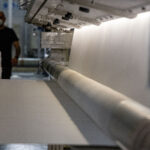
In the air-laid process, fibers are dispersed within an air stream and deposited in a controlled way onto a forming belt.
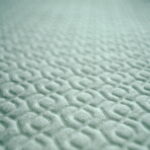
This method makes it possible to create a uniform fibrous structure and to work with different combinations of fibers and components.
The final structure therefore depends not only on the raw materials used, but also on how the fibers are distributed and organized during the process of the web formation.
Fiber distribution and structure
One of the key characteristics of air-laid technology is the ability to control the distribution of fibers within the web.
Different nonwoven technologies rely on different mechanisms to form the material. In air-laid, the dispersion of fibers through an air stream allows manufacturers to work on structural properties such as:
- uniformity
- bulk
- porosity
- absorbency
- fluid distribution
These characteristics are particularly important in applications where the material needs to manage, distribute or retain fluids.
A structure designed around its function
Another important aspect is the possibility of combining different fibers and components within the same structure.
Cellulose fibers, thermoplastic bicomponent fibers, binders and functional components can be integrated according to different formulations and specific performance requirements.
This makes it possible to adjust parameters such as basis weight, density, porosity and composition, designing the material around its intended application.
The structure is therefore the result of several variables working together rather than a single material characteristic.
What changes compared with other nonwoven technologies?
There is no single nonwoven technology that is universally suited to every application.
Different technologies respond to different requirements and rely on specific forming processes, fibers and bonding systems.
The distinctive potential of air-laid technology lies in the ability to engineer the fibrous structure and combine different components to develop materials particularly suited to absorbent and functional applications.
The relationship between process, structure and application ultimately determines how the material behaves.
From technology to function
Understanding how a material is formed also means understanding why it behaves in a certain way.
In air-laid nonwoven materials, fiber distribution, web structure, composition and bonding systems all contribute to properties such as absorbency, uniformity, strength and fluid management.
This ability to design these elements around the application is one of the key characteristics of air-laid technology.
At MAIN, we work every day on this relationship between materials, processes and applications, developing air-laid nonwoven materials designed to meet different functional and performance requirements.
Because the technology behind a material is also part of its performance.