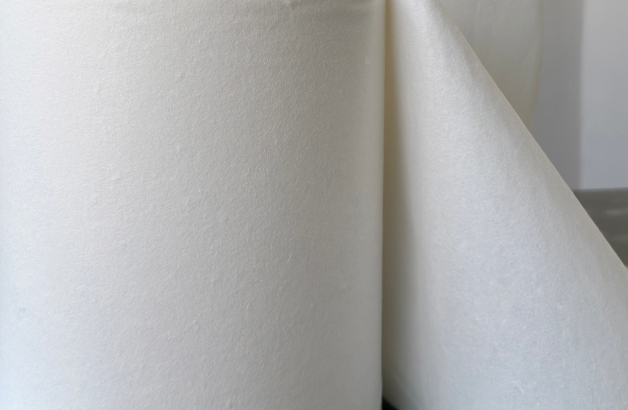
In the absorbent materials sector, performance does not depend on a single element, but rather on how structure, fibers and functionalities work together.
In multilayer air-laid nonwoven materials, each layer is designed to perform a specific function within the system: fluid acquisition, distribution, absorbency, resilience and structural integrity.
It is through this integration that materials are able to meet increasingly advanced technical requirements.
The role of structure in absorbent materials
In absorbent applications, fluid management is a complex balance.
Acquisition speed, uniform distribution, absorbent capacity and stability under pressure must coexist within the same material.
For this reason, multilayer design has become one of the most significant directions in the evolution of air-laid nonwoven materials.
Each layer can be developed using:
- different fibers
- specific basis weights
- various bonding systems
- superabsorbent components
- controlled density and porosity
The possibility of adjusting these parameters makes it possible to create highly customized structures according to the final application.
From function to integrated design
Traditionally, many absorbent applications were developed through the layering of separate materials, each with a distinct function.
The multilayer air-laid approach instead allows multiple functions to be integrated within a single engineered structure.
This leads to several advantages:
- improved fluid distribution
- reduced structural complexity
- thinner and lighter materials
- greater design flexibility
- better performance control
In this context, performance results from the balance between layers and from their ability to work together as a unified system.
A market moving toward higher-performance materials
The evolution of multilayer structures is part of the broader growth of the nonwoven sector.
According to Smithers, the global air-laid materials market reached a production volume of approximately 574,800 tons in 2022, with strong growth prospects in both volume and value over the coming years. Key trends include increasing demand for multi-bonded and thermal bonded solutions, growing attention to sustainability and the need for increasingly high-performance materials across hygiene and absorbent applications.
At the same time, new application areas are expanding the role of air-laid materials beyond traditional sectors. Technical packaging, insulation and molded materials are emerging growth areas, driven by the search for lighter and more functional alternatives to conventional materials.
Performance and sustainability
The evolution of multilayer materials is not limited to technical performance alone.
Integrated design also makes it possible to optimize resource use, reduce structural redundancies and develop materials that are more efficient from a functional perspective.
At the same time, increasing attention is being placed on:
- renewable-based fibers
- compostable components
- more efficient manufacturing processes
- reduction of environmental impact
According to market analyses, one of the main growth drivers in the air-laid sector is the increasing demand for sustainable and high-performance materials in hygiene and personal care products.
Toward a new generation of absorbent materials
In the world of air-laid nonwoven materials, structure is not simply a technical component.
It is the point where functionality, performance control and material design converge.
And it is precisely through the interaction between layers that the next generation of absorbent materials takes shape.