In technical materials, achieving the required performance is only part of the challenge. The other part is being able to reproduce it consistently.
In air-laid nonwoven materials, characteristics such as absorbency, fluid distribution, strength and structural integrity also depend on the stability of the manufacturing process. Variations in fiber distribution, basis weight, density or bonding can directly influence the final behavior of the material.
Uniformity starts with structure
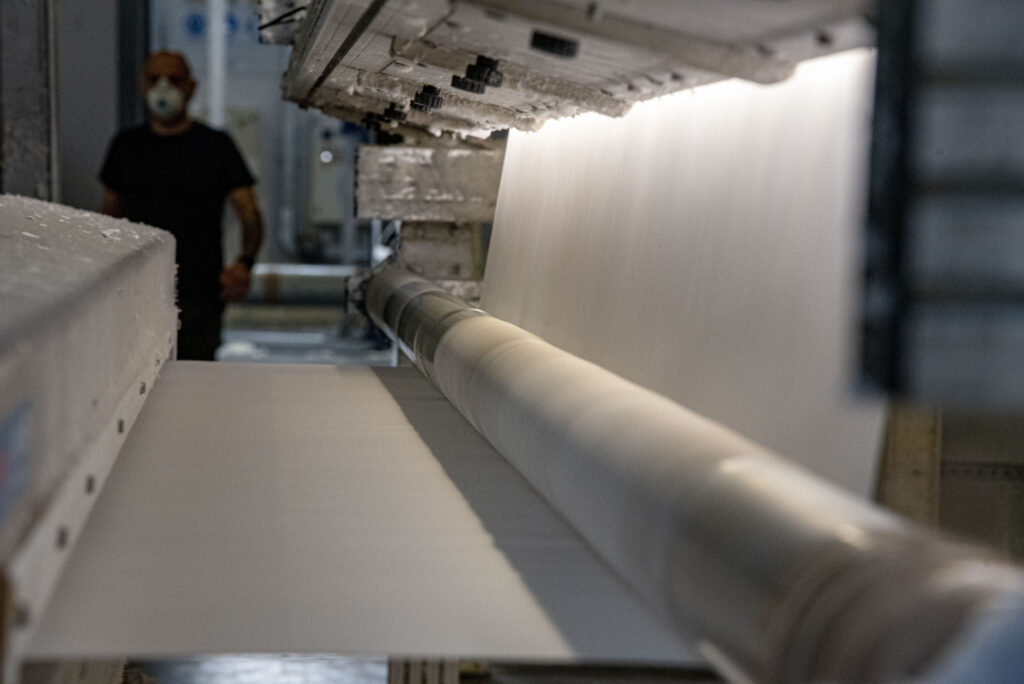
Air-laid technology involves dispersing fibers in an air stream and depositing them in a controlled way to form the material.
Uniform fiber distribution helps maintain consistent density, basis weight and functional properties throughout the structure.
Process control is therefore not only about achieving specific parameters, but also about maintaining them consistently throughout production.
The complexity of multilayer structures
In multilayer structures, process control becomes even more important.
Each layer can have a specific composition and function — from fluid acquisition and distribution to absorption — while final performance depends on how all these layers interact.
Fiber ratios, basis weight, bonding and component distribution must therefore achieve a precise and, above all, repeatable balance.
From performance to repeatability
In industrial applications, quality also means consistency.
A material must maintain its characteristics across the structure, throughout the production run and from one batch to another.
Greater process stability can also help reduce off-spec materials, reprocessing and waste, creating a direct connection between quality control and resource efficiency.
Absorbency, strength or fluid distribution can be measured through individual tests. True industrial reliability emerges when those same performance levels can be reproduced consistently over time.
In other words, performance must also be consistent.